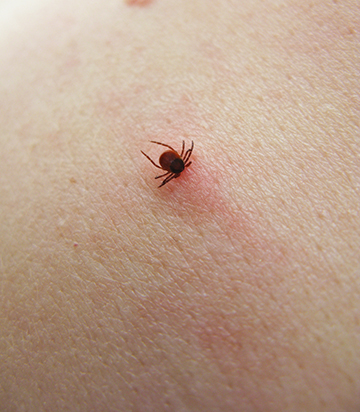
Ticks: troublesome blood-suckers
Article08. 07. 2019
There are two main tick-borne diseases that can be transmitted onto humans: tick-borne encephalitis and Lyme disease. What’s the difference between these two diseases? How can you prevent them, and how do we treat them?
Tick-borne encephalitis (TBE)
The virus responsible for this disease is the tick-borne encephalitis virus (TBEV), which belongs to the family of Flaviviridae. A person can get infected directly via a tick bite, but this virus can also be contracted by ingesting unpasteurized milk from infected cattle (goat, sheep, cow). Tick-borne encephalitis is also associated with outdoor recreational activities, such as hiking, running, mushroom hunting or cycling in areas with meadows and thickets along the edge of forests or rivers. However, areas with outbreaks of infected ticks can reach into suburban areas, gardens and parks. The carrier of TBE in our country is the common tick Ixodes ricinus, and the virus cannot be transmitted through person-to-person contact. The most common casualty of this disease are foreigners who are not aware of the risks upon their arrival to the Czech Republic. This way, TBE can be spread to countries in which this virus does not naturally occur.
Incubation Period
The incubation period of the disease starts the moment the virus enters the body, and it can last anywhere from 7-14 days, but can last as long as a month. The first stages of tick-borne encephalitis are rarely described; the patient usually presents with flu-like symptoms (fever, headache, etc.). The second phase, however, starts to involve the central nervous system, and manifests itself as meningitis, in more serious cases encephalitis, in the most severe cases as encephalomyelitis, and rarely as radiculitis (i.e. the inflammation of the spinal nerve roots). The number of cases of encephalitis and encephalomyelitis increase with the increasing age of patients, and impaired consciousness, polio, intensive care treatment, and artificial pulmonary ventilation and death are increasingly common.
How to protect yourself
There is no specific virostatic (drug that inhibits viral replication) for TBE. The first phase of the disease can be easily treated using antipyretics and analgesics. The meningitic aspect of the disease requires basic symptomatic treatment, after which the symptoms usually reside, but require a long recovery period. The best prevention is vaccination. There are two types of vaccines, both of which are strongly immunogenic and produce neutralizing antibodies. The vaccination is given in three doses and it is advised to start the course in the autumn or winter so that protective immunity is already developed in spring, after the second dose. Further revaccination is recommended every 3 years, despite recent serological results showing that the immunity lasts longer, especially in children and young people. Therefore, doctors now recommend a primary vaccination with three doses of the vaccine, a booster after 3 years, and in younger people a booster every 5 years.
Lyme disease (Lyme borreliosis)
It is the most common infection transmitted by the ticks of the Ixodes genus, that carry the bacteria Borrelia burgdorferi, and can be transmitted by a tick in any of its developmental stages. It cannot be transmitted through person-to-person contact. It is, however, possible to get infected through the contents of the ticks body, for example when a person squishes and rubs a tick in between their fingers. More than 200 species of mammals, reptiles and birds (especially rodents, squirrels, dogs, cats, sheep, goats, deer, wild boar and cattle) can transmit the disease, humans are just incidental hosts. Borrelia bacteria have also been shown to infect other insects, however, there is no proof that they can transmit this bacteria to humans. Experts suggest that the bacteria has a hard time surviving in other insects.
Clinical presentation and treatment of borreliosis
The ticks transfer the bacteria onto the human 36-48 hours after their initial attachment. The bacteria reproduce under the skin, and then are transported around the body to other organs via the blood and lymph system. Borreliosis is a systemic disease that affects the skin, joints, eyes, nerves, heart and other tissues. A red rash/spot with a pale middle appears in the area on which the tick was attached to within 14 days to 1 months after initial contact, and is called erythema migrans. A much more rare presentation of this disease, especially in children, is a borelius lymphocyte. It is a swelling of a deep red to violet color with a smooth and glossy surface, ranging from a few millimeters to 5 cm. It appears several weeks after the initial infection, most often on the ear lobe, but also on the tip of the nose, the nipple or the scrotum.Other symptoms include fatigue, burning of the skin, and 1-3 months after infection, neurological problems may present (tics, jerking of the muscles, paraesthesia, dizziness, irregular heart rhythm), back pain - mainly of the cervical spine, between the shoulder blades or pain in muscles and joints, and recurrent inflammations can trigger an autoimmune response, e.g. arthritis. Late stages of Lyme disease manifest through subcutaneous degeneration, at least one year or several years after infection.
Lyme borreliosis is determined by lab tests that are only really valid 4 weeks after the tick bite. The disease is treated with beta lactam antibiotics (amoxicillin), or tetracycline in children over 8 years of age.
Correct tick removal
If you happen to discover a tick on your body, and you have access to gloves, disinfectant and tweezers, use them. If in an emergency (i.e. in nature, where you wouldn’t have these tools available), simply using your fingers as tweezers in a pinching and twisting motion. You should not delay the removal of the tick unnecessarily, as the risk of infection increases with the duration of the tick being attached. How to remove it? With tweezers, hold the tick at it’s head (closest to where it is attached to the skin) and twist the tick from side to side until it lets go of the skin. Disinfect the area thoroughly.
Galery